.jpg)
In the global market, the dollar was quoted lower in the early trade with investors looking ahead to the following day's European Central Bank policy decision.

Forex dealers said besides dollar gaining against other currencies in the global markets, increased demand for the American currency from importers and lower opening in the domestic equity market influenced the rupee.

The Indian currency resumed lower at 61.50 per dollar as against the last closing level of 61.46 at the Interbank Foreign Exchange Market.
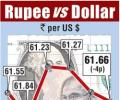
Dealers attributed the fall in rupee to gains made by US dollar against the euro and other overseas currencies ahead of US jobs data and a lower opening in the domestic equity market.

India plans to launch trading of government bond futures within the next two months as part of efforts to deepen its financial markets, according to several sources involved in the discussions with the central bank.

Global currency market sentiment is likely to be driven by the US deficit and debt ceiling negotiations, with markets likely to turn more risk averse closer to October 17, the date by which the US Congress must approve raising the country's borrowing limit.

The improvement in the current account deficit is expected to provide a major reprieve to the government and the Reserve Bank of India which have been battling to prop up the rupee.

The RBI recently met with a handful of foreign banks and asked them to stop acting as market-makers for rupee NDFs, according to three bankers involved in the discussions.

The RBI's comments, announced after trading hours on Wednesday, comes as yields had risen by 60 basis points after a surprise hike in the repo rate on Friday and on worries about the fiscal second borrowing programme of the government.

The domestic currency spurted by 425 paise or 6.28 per cent in last five straight sessions.
.jpg)
A higher subsidy burden and lower growth will weaken the country's fiscal metrics, analyst Atsi Sheth said in the presentation.
.jpg)
The central bank was seen selling dollars consistently when the rupee would approach the record low of 68.86 hit on August 28.

The central bank said such loan products, popularly called 80:20 or 75:25 schemes, are likely to expose the banks as well as their home loan borrowers to additional risks.

Goldman says the downgrade reflects the more difficult external funding conditions for Asia as markets increasingly anticipate Fed tapering and eventual exit from unconventional monetary policies.
.jpg)
Policymakers stepped in late Thursday to calm markets.
.jpg)
The rupee slumped to a record low of 65.56 on Thursday and is headed for a sixth straight session of decline.
.jpg)
The 10-year yield was last at 9.27 per cent, up 4 basis points on the day, tracking the rupee recovery.
.jpg)
The rupee tumbled past 63.00 to the dollar, down about 2 per cent on the day and breaching the previous low of 62.03 hit on Friday despite a spate of measures in recent weeks by the central bank and government to defend it.
.jpg)
The worst performing Asian currency of the year so far hit a new life low of 61.80 rupees per dollar on Tuesday, breezing past a previous low of 61.21 hit on July 8. Central bank intervention helped the rupee recover, but by Wednesday it was sliding once again, to stand around 61.41 by 1.30 p.m.
.jpg)
Fag-end dollar selling by exporters helped the rupee to recover lost ground and settle at the day's high of 60.77, a gain of 11 paise. The rupee earlier touched an intra-day low of 61.21 on July 8.
 © 2026 Rediff.com - Advertise with us - Disclaimer - Privacy Policy - Sitemap - Feedback - About us - Terms of use - Grievances